
Collaborative Business Service Design (CBSD) is a best practice rooted in design thinking to better understand IT-driven business services, its characteristics and requirements, from a business perspective. It will help you to identify the needs of the business in a brief document (the service design statement) that supports the business in managing the IT driven business service lifecycle
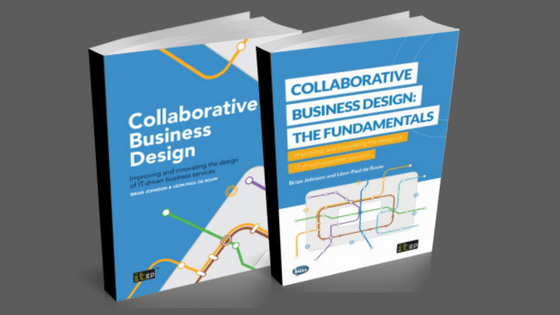
The CBSD approach will help you:
- To promote the coherent design (and possible disaggregation of services) so that fundamental issues and requirements of the requirements are mapped, based on different perspectives between demand and supply.
- To obtain insight into the dynamics between stakeholders within an enterprise.
- To reflect on and formulate a practical and realistic roadmap.
- Explore ideas or problems, and think about and develop possible interventions.
Read all about it in the authors' blog.
What will you achieve using CBSD?
- You will need to think about ten strategic issues relating to outcome and output
- The analysis will enable all stakeholders to be clear about what the business wants and needs, what providers should and can deliver, and what essential requirements should be part of the final design and delivery.
- Using CBSD, you will gain improvement across the total service lifecycle, which leads to improved operational excellence, more customer intimacy, faster time to market and more strategic agility.
- The answers are written in a SERVICE DESIGN STATEMENT, a short document not more than 15-18 pages in a language business understands
- You will derive a SERVICE DESIGN STATEMENT before you start designing, prototyping and developing.
Service Design Statement
Service design statement: max 10-15 pages about ten Strategic Issues
- Service offering - description and justification of the service offering
- Service offering - output of the desired service design, outcome of the desired service design and how output relates to outcome.
- Customers and users - insight about motivations, needs and expectations (various actors involved in the target service are identified, their needs and responsibilities described).
- Managing delivery - how delivery of the service is to be managed and coordinated and any dependencies on support processes.
- Requirements for the service offering.
- Requirements for the complete service offering by all the stakeholders:
- Operational - insight into system requirements, functional requirements, transaction and external interfaces.
- Quality - attributes and features.
- Governance - insight and requirements of business strategy, business information and business rules.
- Requirements for orchestration (the requirements of the operating model).
- How providers will be able to deliver the needed service offering.
- Whether and to what extent the service offering complies with market standards and commercial off the shelf solutions (COTS) or if it is to be ‘custom made’.
- Insight into constraints and critical resources needed.
- Insight into the risks and understanding of countermeasures involved in managing risk.